Wulong Karst Three Natural Bridges:
Day Trip Guide From Chongqing
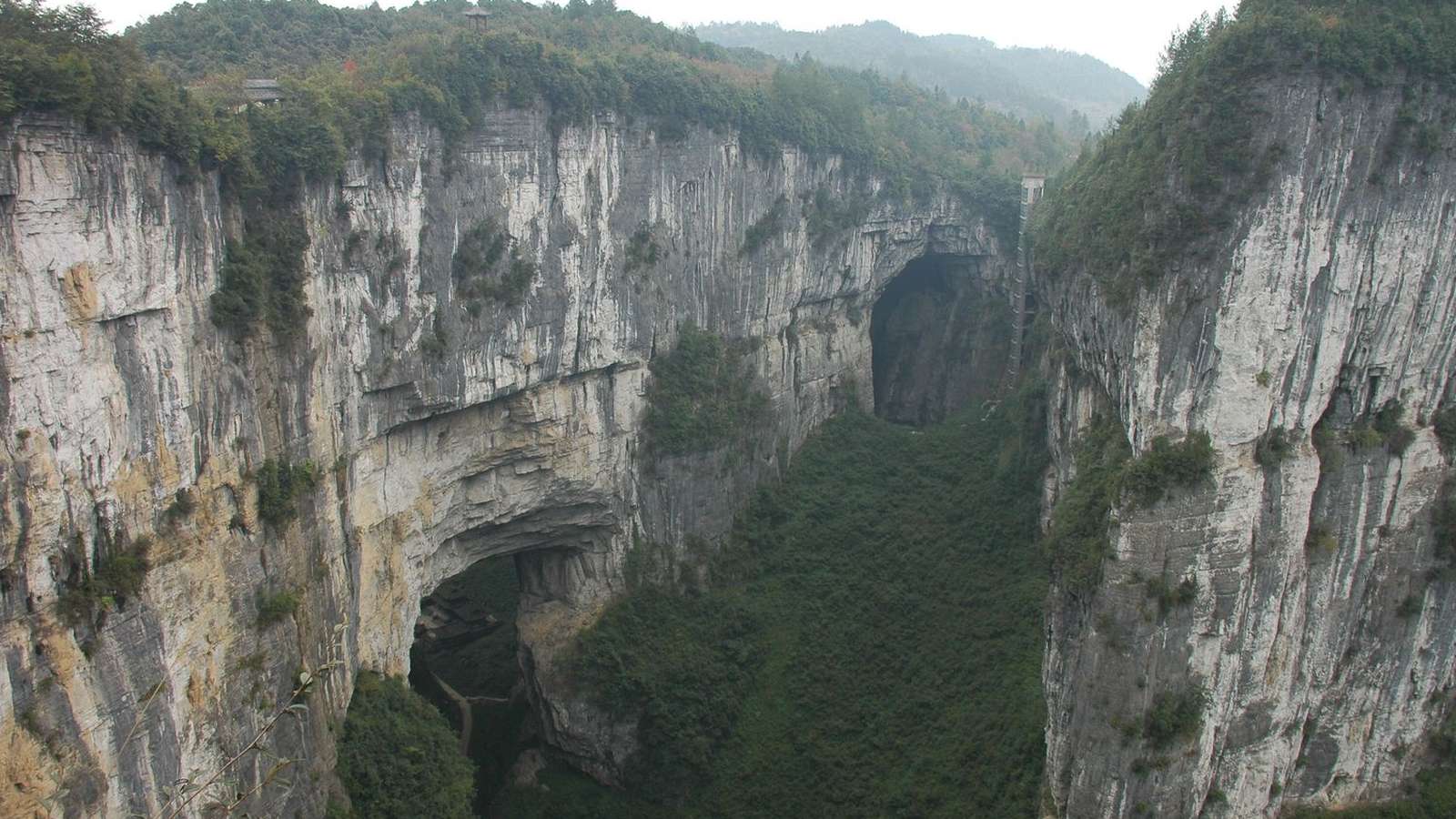
Southeast of Chongqing's neon skyscrapers, a cliffside elevator drops you into a misty prehistoric limestone gorge spanned by three colossal natural stone arches. Here is how to navigate the Three Natural Bridges, Tianfu Official Posthouse, the cliffside glass viewing platform, and the train-to-shuttle transfers in one clean day.
UNESCO Heritage Background: Why Wulong Karst Is Unique
Inscribed on the UNESCO World Heritage List in 2007 as a flagship component of the South China Karst (alongside Shilin Stone Forest and Libo), Wulong preserves a rare textbook chain of giant karst landforms: collapsed sinkholes (Tiankeng), subterranean river valleys, Furong Cave, and the largest cluster of natural limestone bridges in Asia. Carved over millions of years by underground rivers cutting through soluble rock, the three bridges stand in sequence within just 1.2 km—connected by two deep sinkhole valleys.
The Three Natural Bridges & Tianfu Official Posthouse (One-Way Walk)
The scenic route inside the gorge is a one-way downhill walk (~3 km, 2–2.5 hours), so you never have to climb back up the vertical cliff:
- Tianlong Bridge (天龙桥 / Sky Dragon Bridge, 235m tall): The first massive stone vault greeting you at the bottom of the elevator. Its twin arches frame the valley floor and drop directly into Tianlong Sinkhole.
- Tianfu Official Posthouse (天福官驿): Nestled right at the base of the sinkhole beneath sheer limestone cliffs, this grey-tiled Tang-style courtyard originally served as a mountain courier relay station and was rebuilt for Zhang Yimou's film Curse of the Golden Flower (and later featured alongside the canyon in Transformers: Age of Extinction). Climb the short side stairs behind the courtyard for the classic overhead roof-and-bridge shot.
- Qinglong Bridge (青龙桥 / Azure Dragon Bridge, 281m tall): The tallest of the three arches. Around midday when sunbeams pierce the canyon mist, water spray turns the gap beneath the arch into a giant illuminated blade.
- Heilong Bridge (黑龙桥 / Black Dragon Bridge, 223m tall): Deeper and darker than the first two arches, lined with four delicate cave springs (Fog Spring, Pearl Spring, One-Line Spring, and Three-Tier Spring) trickling directly from the rock ceiling.
Glass Viewing Platform & Cliffside Elevator
- Glass Cliff Viewing Platform (玻璃眺台): Perched on the upper cliff rim roughly 280 meters above the gorge floor, this cantilevered glass walkway extends out over Tianlong Bridge for a vertigo-inducing top-down view before you descend. It requires a separate small add-on ticket (~30–40 RMB) and shoe covers; skip it if thick mountain fog has zeroed out visibility.
- 80-Meter Glass Cliff Elevator (观光电梯): Included in the main route down into the sinkhole (expect 15–30 minute queues on weekends; stairs are also available if you prefer walking down). Once you reach the gorge exit at the far end, you can walk 15 minutes uphill to the shuttle lot or pay 15 RMB for the 3-minute electric buggy.
Getting From Chongqing to Wulong
- Train (Chongqing North / East → Wulong): High-speed trains cut the rail leg under an hour, while regular trains from Chongqing North take ~2 hours (~24.5 RMB). From the station, take the blue shuttle bus (~10 RMB, 35 min) or a taxi (~60 RMB) up to Fairy Mountain Visitor Center.
- Direct Coach Bus: Departs from Chongqing Sigongli Transport Hub (四公里交通枢纽) to Wulong (~2.5–3 hours), then local transfer to the Visitor Center.
- Tickets & Passport: Main Three Natural Bridges admission (including eco-shuttle + elevator) runs ~125–155 RMB depending on season; bring your original passport.
Guided Tour vs DIY Independent Trip: How to Decide
| Factor | DIY Independent (Train + Buses) | Guided English Day Tour |
|---|---|---|
| Transport Legs | 4 legs each way (Metro → Train → Uphill Bus → Park Shuttle) | 1 direct coach/van from Jiefangbei/hotel straight to Visitor Center |
| Approx. Cost (1 Person) | ~240–320 RMB (transport + Three Bridges; add ~105 RMB for Longshuixia Gorge) | $55–$110 USD (usually bundles transport, tickets & English guide) |
| Fitting 2 Attractions | Tight—requires catching an ~07:30 morning train to add Longshuixia Fissure Gorge | Smooth—comfortably pairs Three Natural Bridges + Longshuixia Gorge (or Fairy Mountain) |
| Best Choice For | Budget travelers staying 1 night in Fairy Mountain Town | Most single-day round-trips from downtown Chongqing |
Reserve Your Wulong Day Tour or Train Seats Early
Weekend morning trains sell out several days in advance. Prefer ancient cliff sculptures over canyon stairs? Read our Dazu Rock Carvings guide or compare both in Dazu vs Wulong.